A common misconception outside Central Europe is that Wiener Schnitzel is shallow-fried like a steak or deep-fried in an industrial basket. Both methods fail to reproduce an authentic Viennese result.
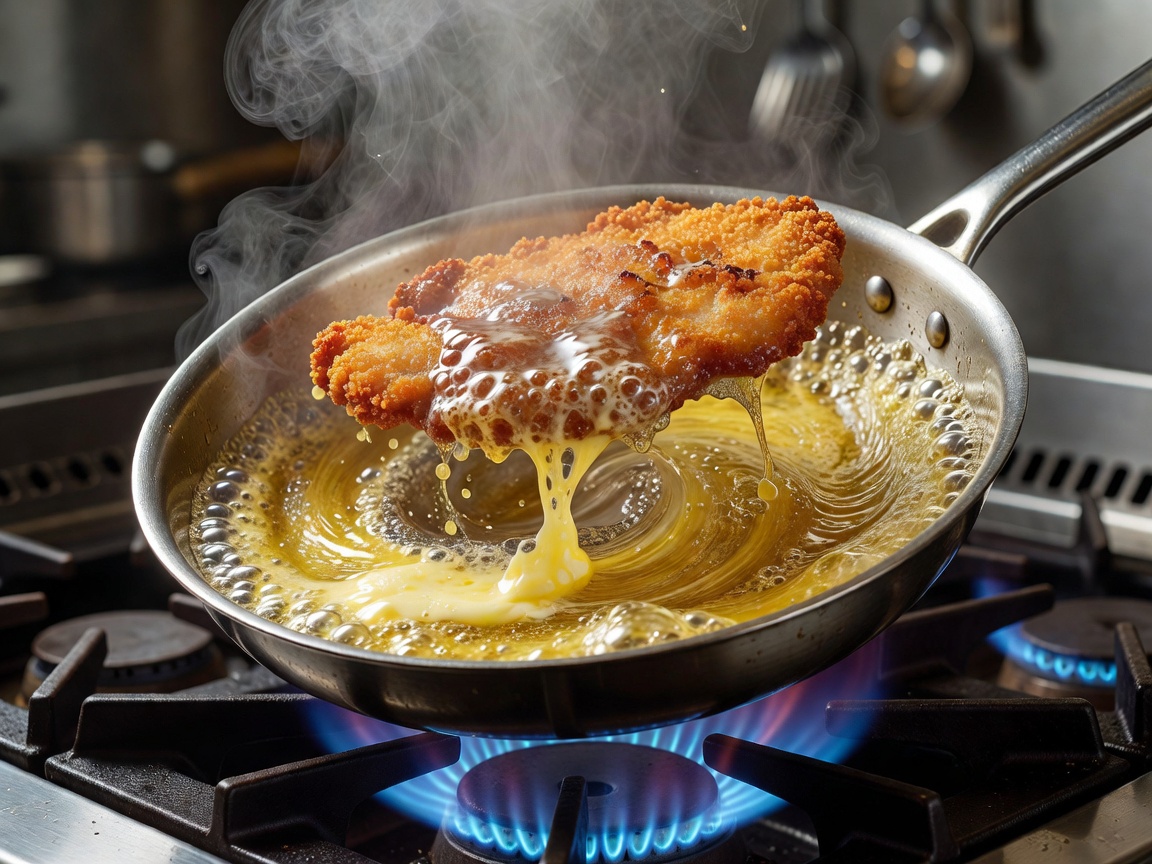
Traditional schnitzel frying is a dynamic process of shallow floating in clarified butterfat accompanied by continuous physical swirling (Schwungieren). This technique forces waves of hot oil to cascade over the top surface, producing a crisp, golden-crusted soufflé.
The Fat Medium: Why Clarified Butter is Essential
Raw dairy butter contains water and milk solids that scorch at 150°C, producing blackened crumbs. Authentic Viennese establishments utilize one of three cooking fats:
| Frying Medium | Smoke Point | Flavor Profile | Traditional Standing |
|---|---|---|---|
| Clarified Butter (Butterschmalz / Ghee) | ~250°C | Rich, nutty, aromatic dairy notes | The Gold Standard |
| Pork Lard (Schweineschmalz) | ~190°C | Clean, savory, exceptionally crisp finish | Historic Rustic Standard |
| High-Oleic Sunflower / Rapeseed Oil | ~225°C | Neutral palate | Commercial Alternative |
For the ultimate balance of flavor and crispness, Austrian restaurants frequently prepare a 70/30 blend of clarified butter and clean pork lard.
Fat Volume: The Floating Condition
The cutlet must never touch the bottom of the pan while resting flat. Pour enough fat into a wide, heavy-bottomed frying pan (cast iron or heavy copper) so that the depth reaches between 2 and 3 centimeters. The escalope must literally float upon a cushion of hot fat.
Thermal Discipline: 170°C to 180°C
Bring the clarified fat to 175°C. You can verify this without a thermometer by dropping a small breadcrumb into the pan; it should immediately sizzle and brown within 10 seconds without smoking. If the oil is below 160°C, the breadcrumbs will soak up liquid fat, leaving you with an oily schnitzel. If it exceeds 190°C, the breading will burn before the inner veal cooks through.
The Pan-Swirling Motion (Schwungieren)
Carefully lay the breaded schnitzel into the pan away from you to avoid hot oil splatters. Immediately pick up the skillet handle and begin circular rocking motions:
- Continuous Movement: Move the pan back and forth over the burner. The fat will form cresting waves that wash over the upper, uncooked side of the breading.
- The Soufflé Effect: This rapid thermal exposure cooks the egg wash from both sides simultaneously. As the veal juices heat, water rapidly vaporizes into steam, pushing the loose breading outward into signature waves and wrinkles.
- The Turn: After approximately 90 to 120 seconds, when the underside is rich golden brown, flip the cutlet using two smooth wooden or silicone spatulas. Never pierce the meat with a fork, as punctures allow vital meat juices to escape into the fat.
- The Second Side: Fry the reverse side for an additional 60 to 90 seconds while continuing the gentle swirling motion.
Draining and Degreasing
Lift the golden schnitzel vertically from the pan, letting excess butter drip away for 5 seconds. Transfer immediately to a preheated wire cooling rack layered with absorbent unbleached kitchen paper. Lightly blot the top surface and serve immediately while the crust is at peak crispness.