In Viennese gastronomy, the coating of a Wiener Schnitzel is not an adhesive crust glued rigidly to the meat; it is an airy, billowing golden envelope. This phenomenon is known as "souffléing" (soufflieren).
The entire assembly relies on a precise three-stage breading assembly line—traditionally referred to as the Panierstraße. Understanding the biological chemistry of each station determines whether your finished schnitzel puffs elegantly or turns into a heavy, soggy bread jacket.
The Setup: Linear Assembly
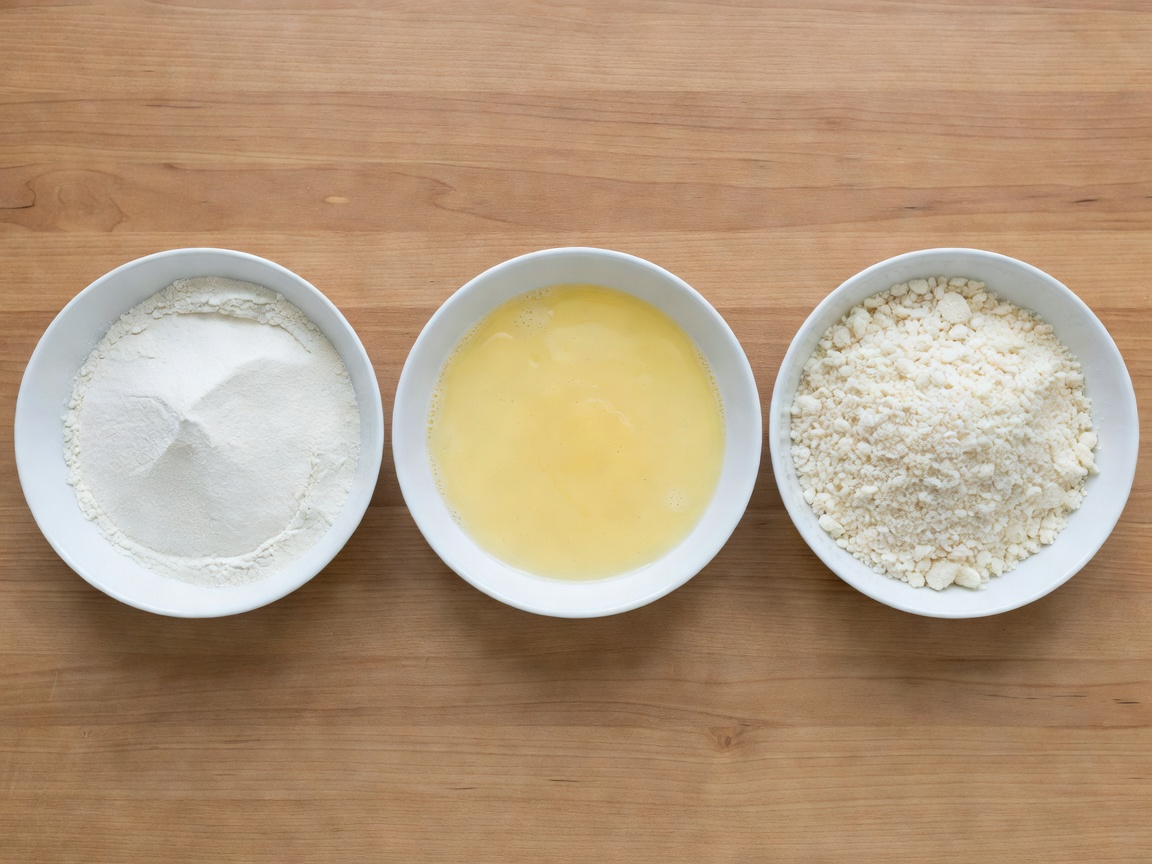
Arrange three wide, shallow rimmed dishes or stainless-steel trays sequentially from left to right adjacent to your stove top:
- Station 1 (Flour): Fine Austrian pastry flour (Glattes Mehl Type 480 or standard fine wheat all-purpose flour). Coarse flour will create heavy paste barriers.
- Station 2 (Egg Wash): Farm-fresh eggs. Crucially, beat the eggs lightly with a fork until the whites and yolks blend, but never whisk vigorously into a foam. Whisking incorporates excessive air prematurely and breaks albumen bonds, which thins the liquid so it runs off the meat.
- Station 3 (Breadcrumbs / Semmelbrösel): Authentic Austrian breadcrumbs ground from dry, unseeded white crusty bread rolls (Kaisersemmeln). Industrial golden crumbs or Japanese panko do not yield authentic Viennese texture.
Step-by-Step Application Protocol
Step 1: The Flour Dusting
Season the pounded cutlet on both sides with fine salt immediately before coating. Place the meat flat into the flour dish. Turn once to coat both sides thoroughly. Lift the cutlet by the edge and gently tap the wrist of your holding hand to knock away any excess loose flour.
The Golden Principle: Only a microscopic layer of starch should remain. Excess flour acts as a thermal barrier, forming an unpleasant doughy layer beneath the crust.
Step 2: The Egg Coating
Lower the floured cutlet into the fork-blended egg. Ensure all surfaces, including crevices, are moistened. Lift the cutlet and allow excess egg wash to drain for three seconds back into the bowl. The flour layer bonds with the egg albumen, creating an impermeable steam seal.
Step 3: The Breadcrumb Cradle (The Critical Rule)
Transfer the egg-coated cutlet into the bed of breadcrumbs. Scoop handfuls of crumbs from the sides over the exposed top until fully blanketed. Now comes the defining secret of the Viennese master chef:
If you press down with your palms, you fuse the breadcrumb matrix directly to the egg and meat surface. When moisture inside the veal turns to steam during frying, it will be unable to expand into a separate pocket, completely preventing the schnitzel from souffléing. Simply lift the cutlet gently, shake off loose crumbs, and slide it straight into the hot frying fat.
Immediate Frying Mandate
Once a cutlet enters the breadcrumbs, it must hit the frying oil within sixty seconds. Leaving breaded schnitzels sitting on plates allows meat moisture and egg wash to soak into the breadcrumbs, resulting in a damp paste that burns instead of crisping.