The physical transformation of a thick cutlet into a broad, gossamer-thin canvas is the hallmark of true Austrian technique. A genuine Wiener Schnitzel is beaten to an exact thickness of approximately 3 to 4 millimeters.
This thinness serves two crucial culinary functions: it tenderizes delicate muscle fibrils without heating them, and it guarantees that the inner meat cooks through completely during the short window of two to three minutes in hot fat required to achieve a golden crumb crust.
Tool Selection: Smooth Mallet vs. Spiked Cleaver
One of the most widespread kitchen errors is the employment of a spiked or pyramid-faced meat mallet (often termed a tenderizing tenderiser). For delicate veal, a spiked mallet is destructive:
- Spiked Mallets: Punches puncture holes directly through the cellular walls. As a result, delicious juices escape onto the board, and the breading seeps into the meat tears, preventing the crust from lifting.
- Smooth-Faced Mallet (Plattiereisen): A heavy, flat disc of stainless steel or polished chrome (termed a Plattiereisen in Austrian kitchens). It glides and pushes muscle bundles outward laterally rather than pulverizing them downward.
- Heavy Rolling Pin Alternative: In the absence of a professional meat press, a dense wooden French rolling pin provides sufficient mass for sliding expansion strokes.
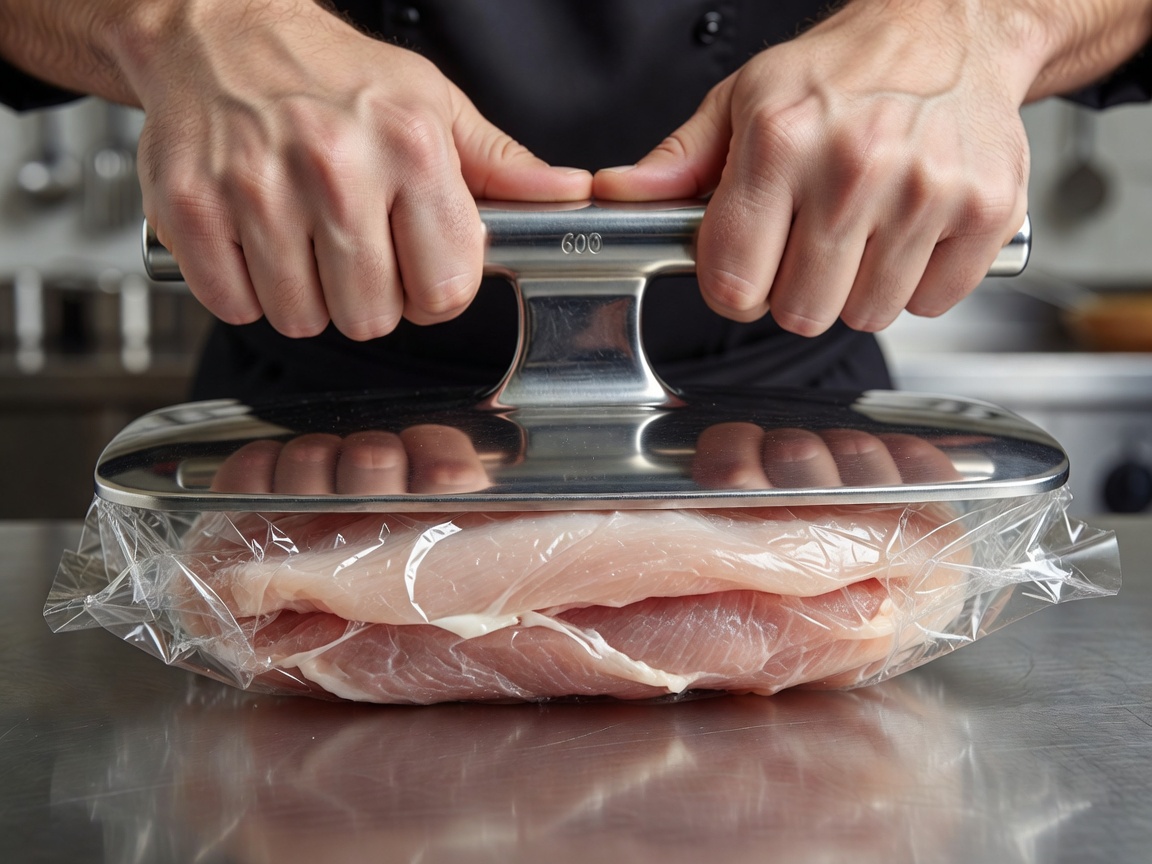
The Protective Barrier: Heavy-Duty Plastic Sheeting
Raw veal must never be struck directly with bare metal or untreated wood. Direct contact results in friction tears and surface sticking. Professional chefs enclose the butterfly cutlet inside a split heavy-gauge food-grade freezer bag or between two sheets of cling film brushed with a microscopic drop of cold water or vegetable oil.
The moisture drops reduce friction, permitting the flattened meat to slide effortlessly outwards against the polyethylene film as lateral force is delivered.
The Mechanics of the Glancing Blow
The stroke executed by an experienced cook is not a vertical hammering action, which merely crushes cells. Rather, it is an angled glancing stroke resembling a tennis stroke:
- Start at Center: Focus the initial stroke slightly offset from the anatomical center of the escalope, where the meat is naturally thicker.
- Swing Outward: Apply a stroke that travels downward at a 45-degree angle and slides outward toward the outer edge.
- Rotate the Board: Frequently rotate the plastic sleeve by 45 degrees to maintain an evenly circular or ovular contour.
- Inspect Edge Tapering: Take care not to over-flatten the peripheral borders. The edges must maintain identical 3mm thickness as the core; paper-thin margins will dry out and scorch rapidly during frying.
Salting: Timing and Moisture Leaching
Seasoning with fine sea salt should take place immediately after pounding and directly before dredging in flour. Salting the meat hours in advance draws moisture outward through osmosis, forming a slick surface liquid layer that creates gummy patches underneath the flour coating.