In Austrian culinary tradition, the authenticity of a true Wiener Schnitzel begins with the biological integrity and selection of the meat cut. The legal framework of the Austrian Food Codex (Österreichisches Lebensmittelbuch) explicitly specifies that solely meat from calves may bear the title.
Any alternative preparation—such as pork, turkey, or beef loin—must be transparently advertised as Schnitzel Wiener Art (Viennese-style breaded escalope). To achieve the distinct melt-in-the-mouth texture and delicate flavor profiles characteristic of classic Viennese dining rooms, one must grasp muscle grain structures, fat trimming, and proper butterfly slicing.
Optimal Veal Cuts for Wiener Schnitzel
Not every part of the calf lends itself to the rapid, dry-heat cooking method of pan-frying. Muscle groups requiring long braising or high connective tissue turnover will seize into tough rubber under quick frying conditions. Culinary professionals typically isolate three anatomical cuts:
| Veal Cut | Austrian Term | Characteristics | Suitability |
|---|---|---|---|
| Topside / Top Round | Kaiserteil / Schale | Extremely lean, uniform grain, minimal intramuscular fat, large surface area. | Standard Classic Choice |
| Loin / Saddle | Kalbsrücken | Exceptionally tender, subtle butter notes, smaller circular profile. | Luxury / Gourmet Choice |
| Silverside / Bottom Round | Frickandeau | Slightly more fibrous; requires precise trimming of exterior silver skin. | Economical Alternative |
The topside (Kaiserteil) represents the benchmark across Austrian master butcheries. It offers an unbroken surface structure that stretches smoothly under the mallet without tearing into holes during mechanical flattening.
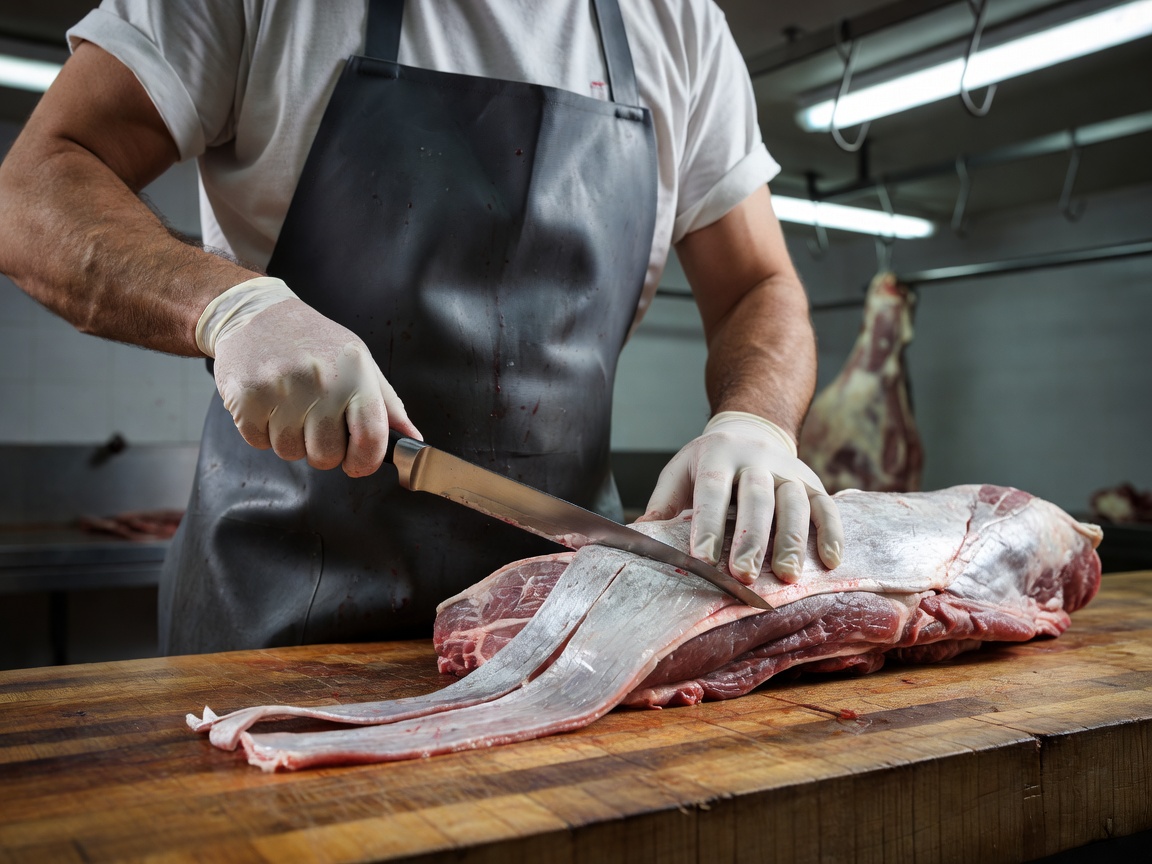
The Butterfly Cut (Schmetterlingsschnitt)
A classic Wiener Schnitzel is renowned for occupying the greater portion of a standard 30cm dinner plate. Yet, unpounded veal medallions are naturally modest in diameter. To create this broad span without having uneven thickness, butchery dictates the butterfly technique (Schmetterlingsschnitt):
- Sanitizing and Drying: Gently pat the whole muscle dry with unbleached parchment. Moisture on the exterior inhibits precise blade traction.
- Initial Incision: Position a razor-sharp, non-serrated chef's knife or slicing knife perpendicular to the grain. Cut a slice approximately 7 to 8 millimeters thick, but halt blade progress roughly 5 millimeters prior to cutting completely through the base.
- Completing the Cut: Advance the knife another 7 to 8 millimeters along the muscle block, cutting entirely through the meat to free the doubled portion.
- Unfolding: Open the two halves along the connective hinge like a book. You now possess a single, continuous escalope weighing between 160 and 200 grams with uniform fiber distribution.
Temperature Management Prior to Breading
Many home cooks make the mistake of pulling meat straight from refrigeration at 4°C directly into flour and oil. Extreme thermal contrast causes two failures: it plunges the fat temperature drastically, causing excessive oil absorption, and causes sudden muscle shock, tightening meat proteins.
Veal cutlets should rest at ambient kitchen temperature for roughly 15 to 20 minutes following slicing and trimming, bringing core temperatures closer to 14°C before proceeding to tenderisation and breading stations.